Federal Reserve Inflation Projections Drive Shifting Social Security Outlook
The Federal Reserve’s economic calculations reveal a severe upswing in inflationary indicators that are rapidly redefining the financial trajectory for millions of retirees. A key forecasting model from the Federal Reserve Bank of Cleveland indicates that consumer inflation is trending toward a steep 6% mark in the second quarter of 2026.
This inflationary wave is being heavily aggravated by persistent energy market stresses. High costs for utilities, housing, and general energy continue to apply extreme pressure to national economic indicators, forcing a substantial re-evaluation of public benefits.
According to official data from the Bureau of Labor Statistics, the energy index spiked by 3.8% in April alone. This singular movement accounted for more than 40% of the entire monthly increase observed across all consumer items combined.
As retail transportation costs move upward due to expensive fuel, these underlying logistical expenses are systematically passed directly to consumers. Consequently, families are experiencing immediate, heightened price points at grocery stores and traditional retail storefronts.
The Mechanics and Timeline of the 2027 COLA Calculation
The Social Security Administration implements an annual Cost-of-Living Adjustment to protect the baseline monetary value of monthly checks from being completely eroded by consumer inflation. However, the federal calculation method does not factor in the price changes across all twelve months of the calendar year.
The government determines the final adjustment rate by focusing exclusively on a specialized metric known as the Consumer Price Index for Urban Wage Earners and Clerical Workers. The mathematical formula evaluates the percent change by comparing third-quarter data year-over-year.
Specifically, the third-quarter average from the current fiscal year is divided by the third-quarter average from the prior year. The resulting difference establishes the exact adjustment percentage that beneficiaries receive starting the subsequent January.
Because the official 2027 COLA relies entirely on data collected from July through September, the finalized percentage will not be formally established until mid-October. The Social Security Administration typically announces the exact rate on the same day the Department of Labor publishes the September inflation figures.
Surging Estimates Point to Historic Benefit Boosts
Early projections compiled earlier in the year initially pointed to a completely flat trajectory for recipients. Initial baseline models placed the potential 2027 adjustment between 2.0% and 3.1%, largely mimicking the 2.8% boost implemented at the start of 2026.
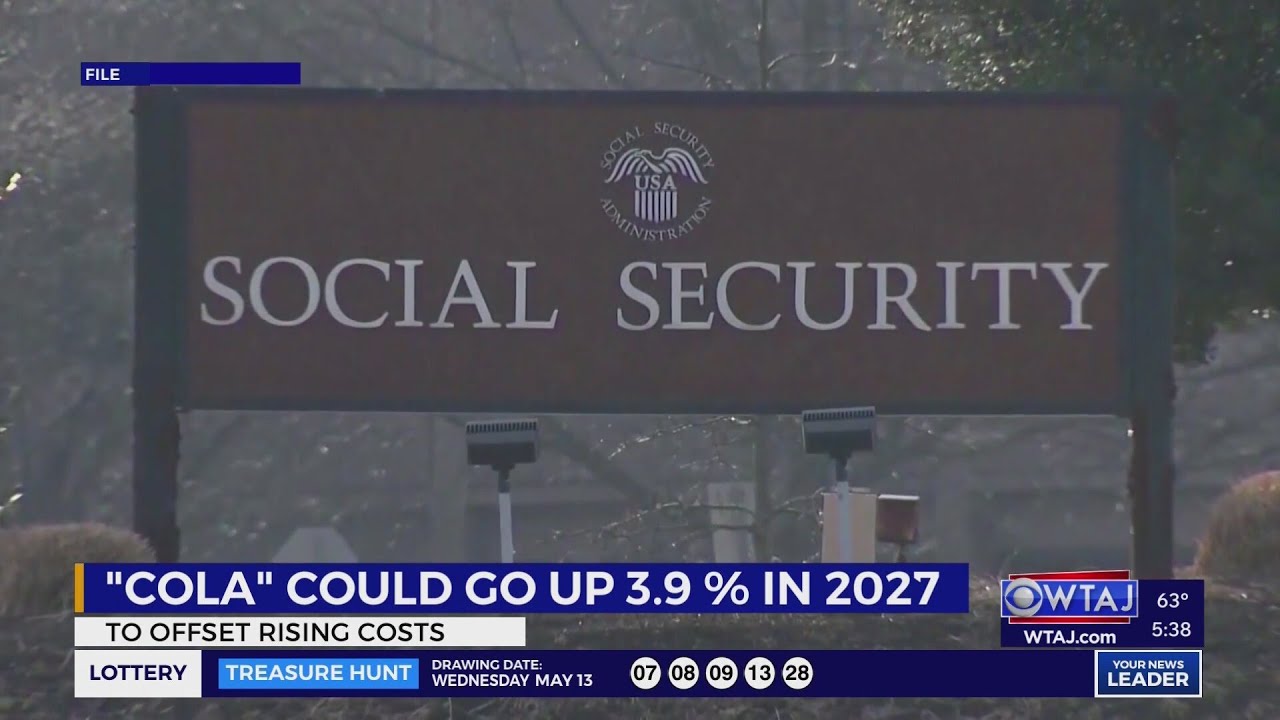
However, the latest rapid acceleration in energy markets has forced prominent advocacy groups to sharply adjust their baseline outlooks. The Senior Citizens League has formally upgraded its 2027 COLA forecast to a substantial 3.9%, marking a notable 1.1% increase in its projection over a single month.
- Current Average Payouts: The typical retired worker currently receives an average monthly benefit of $2,081.16.
- Projected Monthly Increases: If the newly updated 3.9% forecast holds true through the third quarter, it will deliver an average monthly raise of roughly $81.17.
- New Monthly Benefit Totals: A finalized 3.9% boost would effectively elevate the standard monthly check for retired individuals up to $2,162.33.
- Broader Context: Parallel estimates compiled by the nonpartisan Committee for a Responsible Federal Budget place the projected adjustment at 3.8%, while forecasting a total potential range spanning from 3.0% to 4.5%.
A finalized adjustment reaching the 3.9% threshold would hold significant historical relevance for the program. According to tracking data, a 3.9% increase would register as one of the highest standalone adjustments enacted by the agency since 2023.
This shifting outlook follows a steady run of elevated annual adjustments. The program concluded an unusual five-year streak where the annual COLA remained strictly at or above 2.5%, a back-to-back sequence that had not occurred in nearly three decades.
Systemic Buying Power Losses for American Seniors
While a higher headline percentage may appear to be a positive development, independent policy experts emphasize that large upward adjustments are an explicit symptom of harmful underlying inflation. For the vast majority of older Americans, the calculated raises rarely translate into true financial relief.
Research published by senior advocacy organizations reveals that the standard inflation index utilized by the government contains a structural blind spot. The index heavily mirrors the daily spending habits of younger, active workers rather than the actual necessities of older retirees.
Younger corporate workers spend their incomes differently, meaning the tracking system fails to give proper statistical weight to the severe price increases hitting senior households. Essential needs such as housing, utilities, insurance, and medical care are escalating far quicker than the broader national economy.
Due to these systemic discrepancies, a study titled “2026 Loss of Buying Power” asserts that modern Social Security benefits are only worth about 86.3 cents on the dollar compared to their valuation in 2016. To completely recover this lost baseline value, typical monthly payments would need to immediately rise by 15.7%, or an extra $295.85 per month.
Escalating Healthcare Premiums Blunt Monthly Adjustments
The real-world utility of the annual benefit boost is frequently diminished by automatic deductions managed by other federal agencies. The vast majority of retirees have their monthly Medicare premiums pulled directly from their incoming Social Security checks.
The official Medicare program guidelines outline how outpatient hospital services and physician-administered drugs continue to outpace general economic inflation. The 2025 Medicare Trustees Report explicitly warned of a steady, multi-year climb in standard Part B premiums and specialized high-income surcharges.
Long-term federal projections indicate that the standard monthly Medicare Part B premium could potentially spike by 188% over the next decade. If these macroeconomic models prove accurate, the mandatory monthly baseline cost is on track to reach nearly $350 by the year 2034.
This dynamic was clearly demonstrated during the current fiscal cycle, where Part B premiums jumped by a massive 9.7%. That change added an immediate $17.90 monthly obligation, effectively canceling out nearly one-third of the average worker’s previous Social Security raise.
Broader Financial Impacts on Public Trust Funds
The necessity of paying out a significantly higher cost-of-living adjustment threatens to introduce severe logistical complications for federal budget balancers. The nonpartisan Committee for a Responsible Federal Budget warns that an elevated COLA will deeply compound the ongoing funding shortages currently facing the program’s primary trust infrastructure.
Distributing a larger annual payout requires the agency to draw far more extensively on its core reserves than originally anticipated. Analysts calculate that an elevated adjustment cycle will worsen the program’s total financial shortfall by approximately $300 billion over the next ten years.
Furthermore, these accelerated expenditures are projected to advance the official insolvency timeline for the old-age trust fund by approximately three months. This shift moves the expected exhaustion date from late 2032 into an earlier portion of that same year.
Because the calculation structure is entirely backward-looking, beneficiaries are forced to manage high out-of-pocket costs today without any absolute guarantee that the final third-quarter metrics will match their current daily expenses. Seniors are left to navigate a highly volatile energy landscape while relying heavily on alternative personal retirement accounts to stabilize their household budgets.

Charles D. Whitfield
Charles D. Whitfield covers the full spectrum of American life—from breaking news and sports to entertainment, lifestyle, business, and tech. A sharp observer with a direct voice, he specializes in capturing trending stories as they happen, bringing clarity to complex issues and energy to every topic he touches.